Add your promotional text...

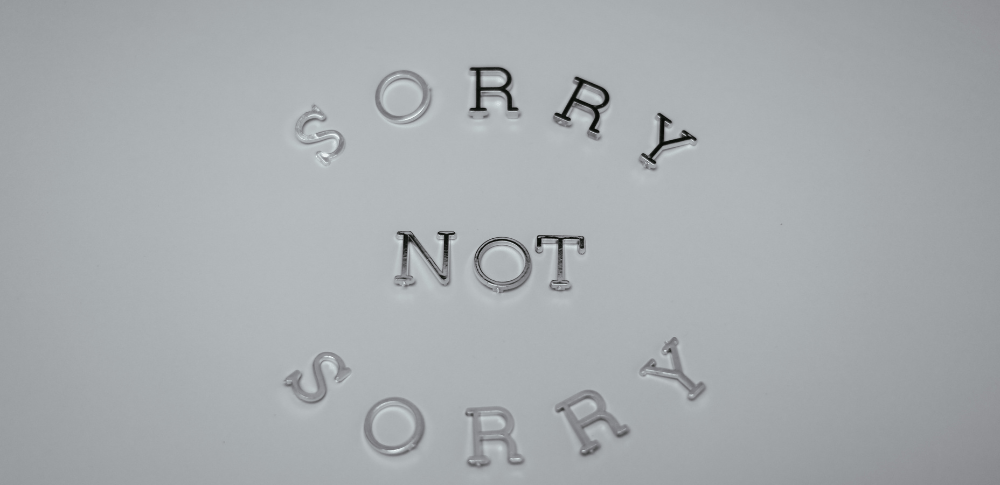
Do Women Say Sorry more often than not?
I’ve noticed how easily the word “sorry” slips out of my mouth now. Sometimes before I even realize why.
Sorry I’m late. Sorry to bother you. Sorry if this doesn’t make sense. And then I catch myself and think… really? What exactly am I apologizing for? What’s interesting is that growing up, I was the opposite. I rarely said sorry. Why? Because apologizing was weakness and I wasn’t going to show it. I had to stand my ground, act like I was always right and everyone else was wrong. Sure, on the surface, it worked. But underneath? Heavy shoulders, a heart carrying armor and times I felt foolish for always needing to prove myself. Now the pendulum has swung and honestly, I’m catching myself apologizing often than not. Not because I’m less confident, but because reading people has become second nature. In sales, I read body language, tone, eye contact. I catch signals. I figure out what people want and then sell it to them. It’s literally my job. And somehow, that habit of smoothing tension at work has followed me home. What worked professionally started showing up personally. Yes, it softens tension. Yes, it works. But sometimes, I step back and go, wait… why did I just apologize? Nothing happened. I didn’t need to. And that little unnecessary “sorry” is frustrating. Apologizing out of habit instead of truth. Here’s the kicker: research backs this up. Women aren’t apologizing more because we’re weak or insecure. Awareness is our strength; we can read the room. We pick up on cues that others might miss. So, the next time someone judges us for saying “sorry” one too many times, science has our back. That awareness shows we care. It keeps us tuned in. But let’s be real… it can also make us feel like we’re carrying everyone else’s comfort on our shoulders. And over apologizing? It can shrink us if we let it. Sometimes growth is learning to apologize. Sometimes it looks like learning not to. Both take awareness. Both take honesty. And both are owning who you are.
Research note:
Studies show women don’t apologize more because they’re weaker, but because they notice and interpret more situations as needing acknowledgment. When men and women recognize an offense, they apologize at nearly the same rate. Newer research adds that context, tone, and social expectations influence how apologies are delivered and received.
Reference:
Schumann, K., & Ross, M. (2010). Why Women Apologize More Than Men. Psychological Science, 21(11), 1649–1655.